
Bleeding gums are one of the most common signs patients ignore a little pink in the sink after brushing, and most people assume it will pass. But bleeding gums are rarely trivial. They are your body’s earliest distress signal that the tissue holding your teeth in place is under attack. Knowing how to read that signal and when it has escalated beyond routine cleaning can make the difference between saving and losing your teeth.
Why Do Gums Bleed? Starting With the Basics
Healthy gum tissue is pale pink, firm, and fits snugly around each tooth. It does not bleed on brushing or gentle probing. When bacteria accumulate at the gumline and are not removed through daily hygiene, they form a soft film called plaque. Left undisturbed, plaque mineralises into calculus (tartar) a hard, porous deposit that cannot be removed by brushing alone. The toxins released by bacteria in this biofilm trigger an immune response, causing the gums to become inflamed, swollen, and prone to bleeding. This early stage is called gingivitis.
Gingivitis is fully reversible with a professional clean and improved home care. The danger is when patients delay treatment and gingivitis advances to periodontitis a deeper infection where bacteria migrate below the gumline, destroying the bone and ligament that anchor your teeth. At this point, the clinical picture changes significantly.
Reading the Diagnosis: What Your Dentist Is Assessing
A thorough periodontal examination includes:
- Bleeding on probing (BOP): A fine instrument is gently inserted into the sulcus (the space between tooth and gum). Bleeding indicates active inflammation.
- Pocket depth measurements: Healthy sulci measure 1–3 mm. Readings of 4 mm or more signal disease.
- Bone loss assessment: Periapical and bitewing X-rays reveal how much supporting bone has been lost.
- Tooth mobility: Loose teeth indicate advanced attachment loss.
- Furcation involvement: In multi-rooted teeth, disease penetrating between the roots is a serious finding.
When multiple sites show pockets of 5 mm or more, combined with bone loss and persistent bleeding, conventional scaling alone may not be sufficient. This is the threshold at which laser gum treatment in Bangalore becomes a clinically justified and often superior option.
Before and After: A Case From Our Clinic
The images below document a patient treated at House of Smiles Dental & Implant Center with significant generalised periodontitis. The pre-treatment photograph shows heavily inflamed, oedematous gingival tissue, visible calculus deposits, and darkened areas consistent with subgingival staining and deep biofilm accumulation. The post-treatment photograph, taken after a combination of deep scaling, root planing, and laser-assisted decontamination, shows dramatically reduced inflammation, tighter gingival margins, and a far cleaner tissue architecture.
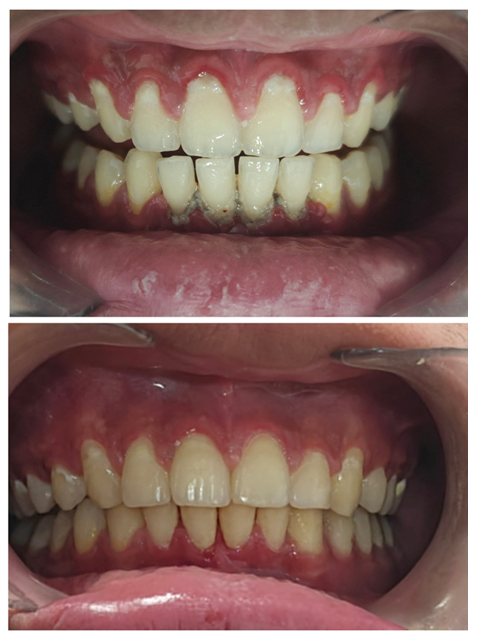
Before (top) and after (bottom): Laser-assisted periodontal treatment at House of Smiles, Indiranagar, Bangalore.
This kind of transformation is not cosmetic. It reflects genuine biological healing — reduced pocket depths, resolution of active infection, and restoration of a healthy sulcular environment.
When Is Laser Therapy Specifically Indicated?
Not every bleeding gum case needs a laser. A simple gingivitis with shallow pockets responds well to a standard ultrasonic clean and polishing. Laser therapy becomes necessary or strongly beneficial in the following scenarios:
1. Deep pockets (5 mm or more) not resolving with conventional therapy
Mechanical scaling is excellent at removing gross deposits, but in deep, narrow pockets, instruments cannot always access and decontaminate the root surface completely. Laser energy penetrates these areas, eliminating residual bacterial biofilm and decontaminating the cementum surface.
2. Persistent bleeding and refractory periodontitis
When patients return for review and pockets continue to bleed despite a previous thorough clean and improved home care, this indicates a refractory biofilm that requires a more aggressive approach. Laser gum treatment in Bangalore at our clinic is frequently the recommended next step in such cases.
3. Patients preferring minimally invasive options
Conventionally, deep pockets that do not resolve with scaling may require surgical flap procedures. Laser-assisted periodontal therapy can in many moderate cases defer or eliminate the need for surgery, as the laser reduces pocket depth through biostimulation and precise tissue management.
4. Medically compromised patients
Patients on anticoagulants, those with bleeding disorders, or individuals with uncontrolled diabetes often carry higher surgical risk. The haemostatic properties of dental lasers — they coagulate as they treat — make laser gum treatment in Bangalore an especially practical option for this group.
What to Expect During Laser-Assisted Periodontal Treatment
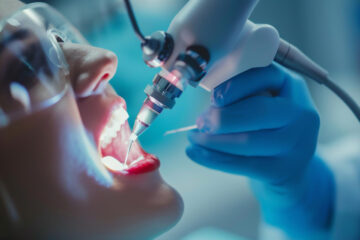
The procedure is typically carried out under local anaesthesia, so patients experience no discomfort. A fine laser fibre is introduced into the periodontal pocket, where it selectively targets and ablates infected tissue and pathogenic bacteria while sparing healthy cells. It also works synergistically with the ultrasonic scaler, which is used first to remove hard deposits. Post-treatment, patients can expect mild soreness for a day or two. There is no incision, no sutures, and recovery is considerably faster than conventional surgery.
The Takeaway
Bleeding gums should never be dismissed as normal. The diagnostic journey — from probing depths to X-rays determines whether your condition is a simple gingivitis or an entrenched periodontitis requiring advanced intervention. If your assessment shows deep pockets, active bone loss, or persistent infection, asking specifically about laser gum treatment in Bangalore is entirely appropriate. It is no longer a niche technology; it is an established, evidence-backed option that produces measurably better outcomes in moderate to advanced cases.
If you have noticed bleeding while brushing, sensitivity along the gumline, or gums that look darker or swollen, book a periodontal assessment at House of Smiles Dental & Implant Center, Indiranagar. Early diagnosis is always your best investment.


1 Comment
How Oral Hygiene Habits Reduce the Risk of Gum Infections – House of Smiles · August 24, 2026 at 11:39 am
[…] you’re experiencing bleeding gums, sensitivity, or want guidance on improving your oral hygiene habits, our team is here to help. […]
Comments are closed.